The Legend
The Divine History
From the reclaiming of the land to the eternal tapas of Muthassan.
The Sacred Genesis
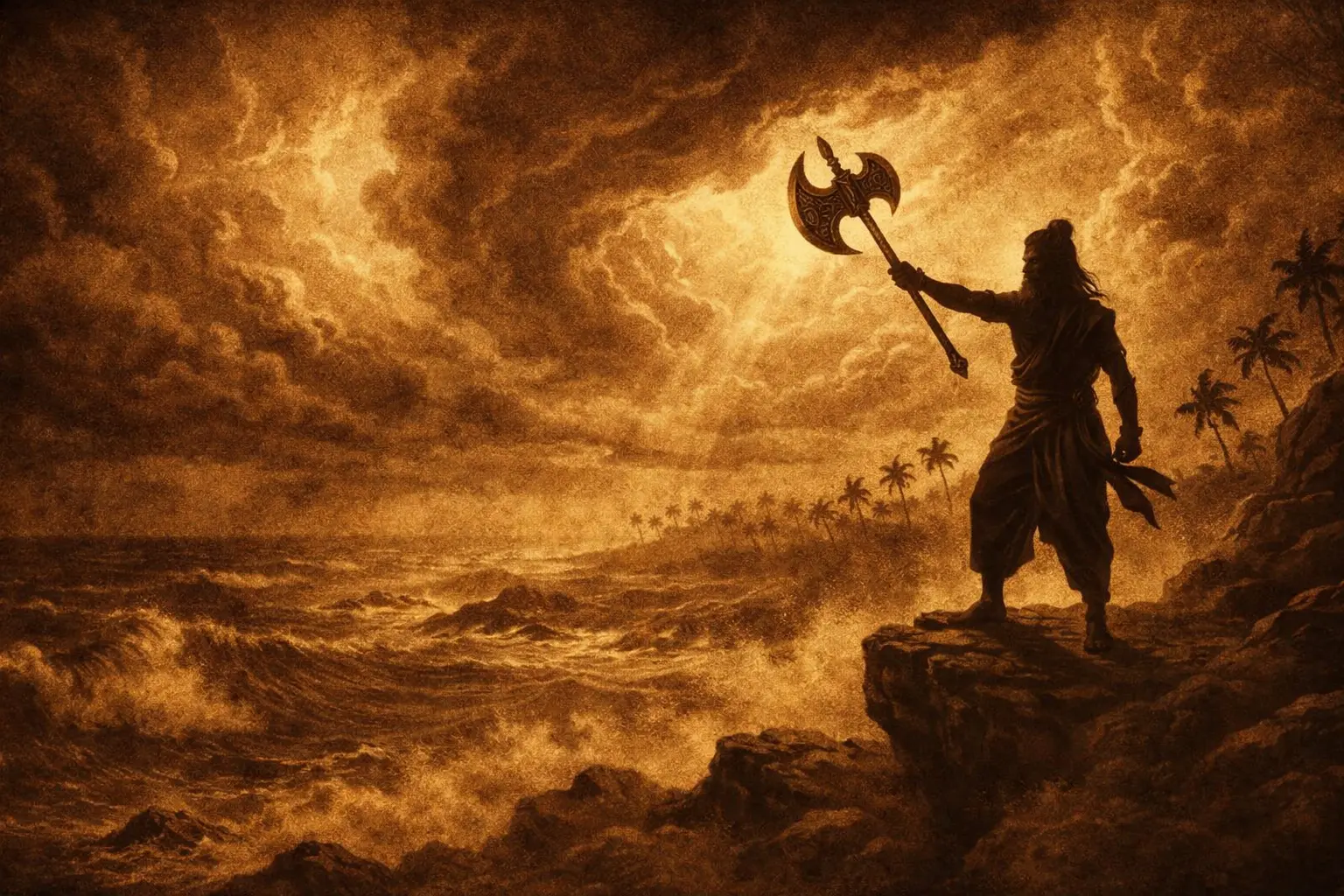
Lord Parasurama looking out at the ocean.
From the mists of legend, Kerala’s birth unfolds—a tale where divine will, human penance, and nature’s primal forces converge. At the heart of this origin lies Mannarasala, the supreme abode of the Nāga Devathas, and its story is woven into the land’s very soil.
It begins with Lord Parasurama, who sought to atone. Upon the counsel of seers, he called upon Varuna, Lord of the Oceans, who granted him a boon: a land reclaimed by the cast of his axe. From the roaring sea rose a verdant expanse—Kerala.
Yet beauty lay dormant. The earth, steeped in brine, refused life. Crops failed; hopes faded. Witnessing this barrenness, Parasurama turned inward, seeking a higher wisdom. In meditation, Lord Śiva revealed the truth: only the sacred, purifying fire of the serpents—the Nāgas—could heal the salt-scorched earth. To awaken this force, he must win the grace of Lord Sree Nāgarāja, the King of Serpents .
With resolve as firm as the mountains, Parasurama journeyed to a secluded stretch along the southern coast. There, where the forest met the sea, he consecrated a sacred space—a tīrthasthala. In profound silence, he offered his deepest tapas, his devotion a steady flame in the wilderness.
Moved by such steadfast reverence, Lord Śree Nāgarāja manifested—a vision of awe and benevolence. Parasurama bowed and voiced his prayer:
“Let this land awaken. Let it grow, flourish, and nurture life.
A gentle assent flowed from the Serpent King. At his divine command, celestial serpents descended, their essence—the Kālakūṭa—seeping like liquid light into the barren soil. Where salt had reigned, fertility now stirred. The earth softened, grew rich, and burst forth in emerald vitality.
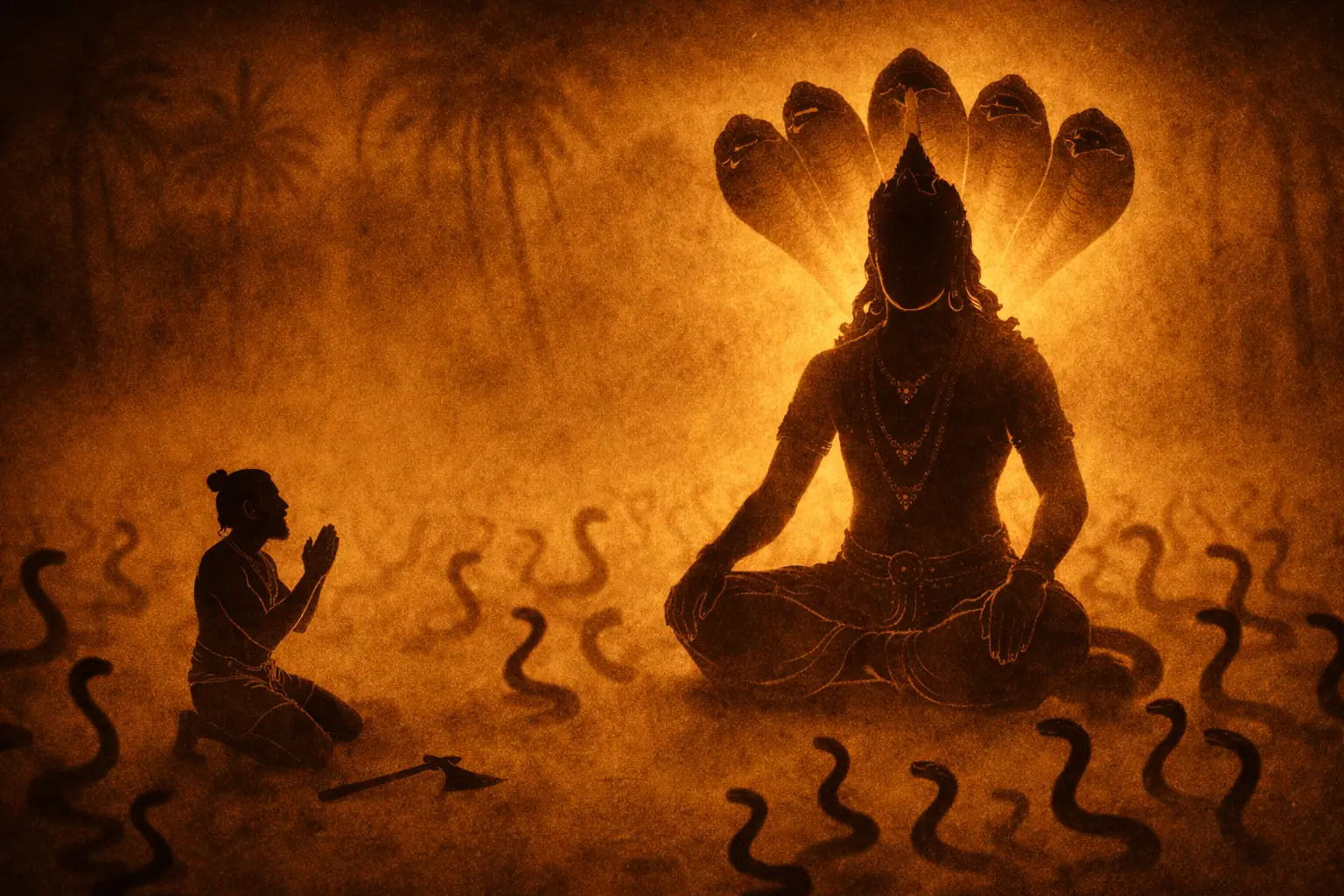
Lord Sree Nagaraja appears before Lord Parasurama
But Parasurama offered one final, heartfelt plea:
“Stay, O Lord. Dwell here always, and protect this land with your eternal presence.
And so it was. The compassionate Lord Sree Nāgarāja chose to remain, blessing that hallowed ground forever.
Thus, Mannarasala became more than a temple—it became a living testament. A place where the earth remembers its healing, where the serpent’s gaze still guards, and where Kerala’ lushness whispers an ancient, divine promise.
The Sacred Consecration
At a moment chosen by the stars, when the heavens aligned in auspicious grace, Parasurama performed the sacred consecration. Guided by ancient Vedic rites, he established Nāgarāja in the hallowed tīrthasthala, cradled by sacred Mandara trees, in a grove then known as Mandarasala.
Here, the consecrated deity embodies the divine unity of creation, preservation, and dissolution—Brahma, Vishnu, and Śiva in one form. In this sacred icon resides the cosmic repose of Ananta (the form of Vishnu) and the potent energy of Vasuki (the spirit of Śiva).
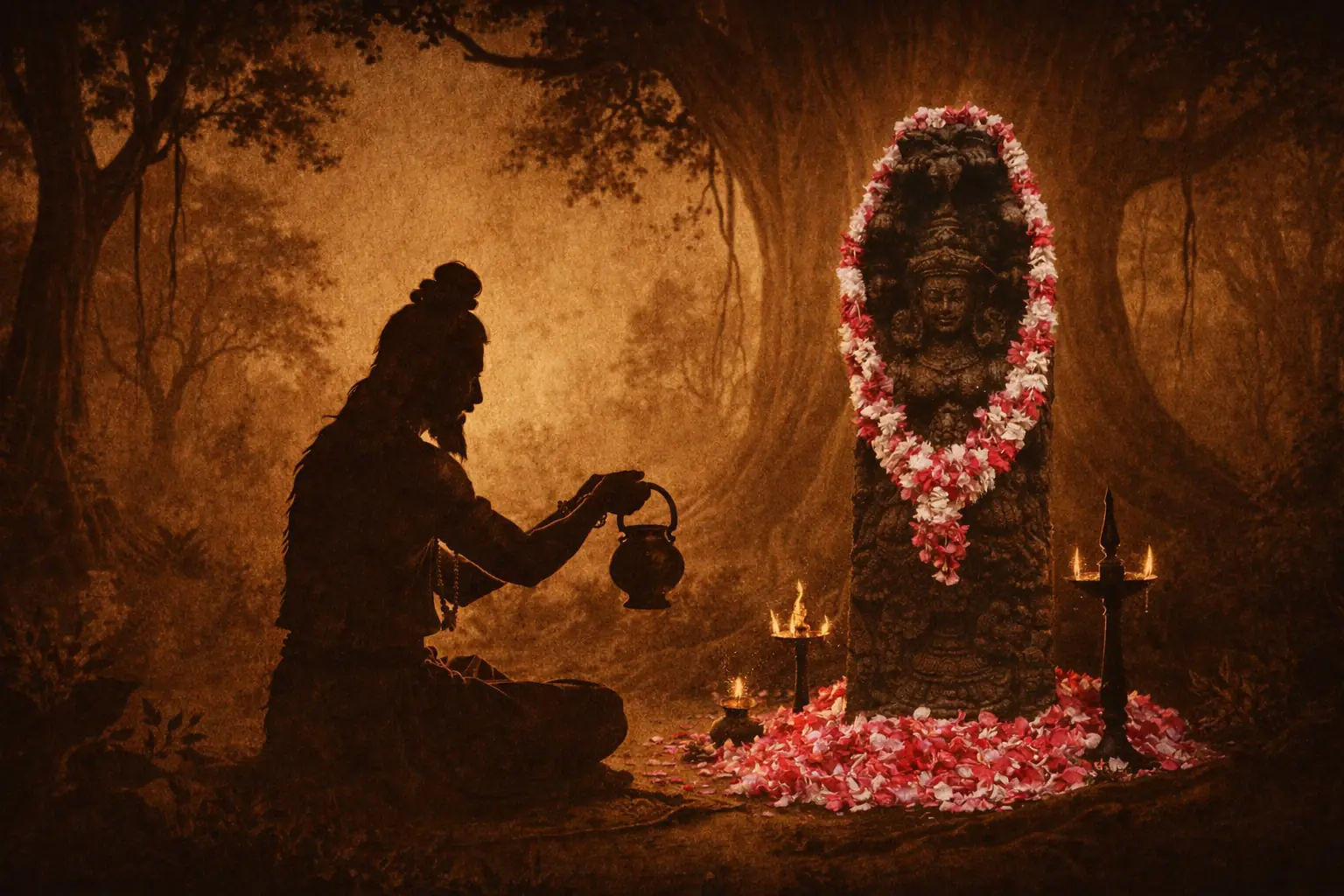
Lord Parasurama performing the sacred consecration.
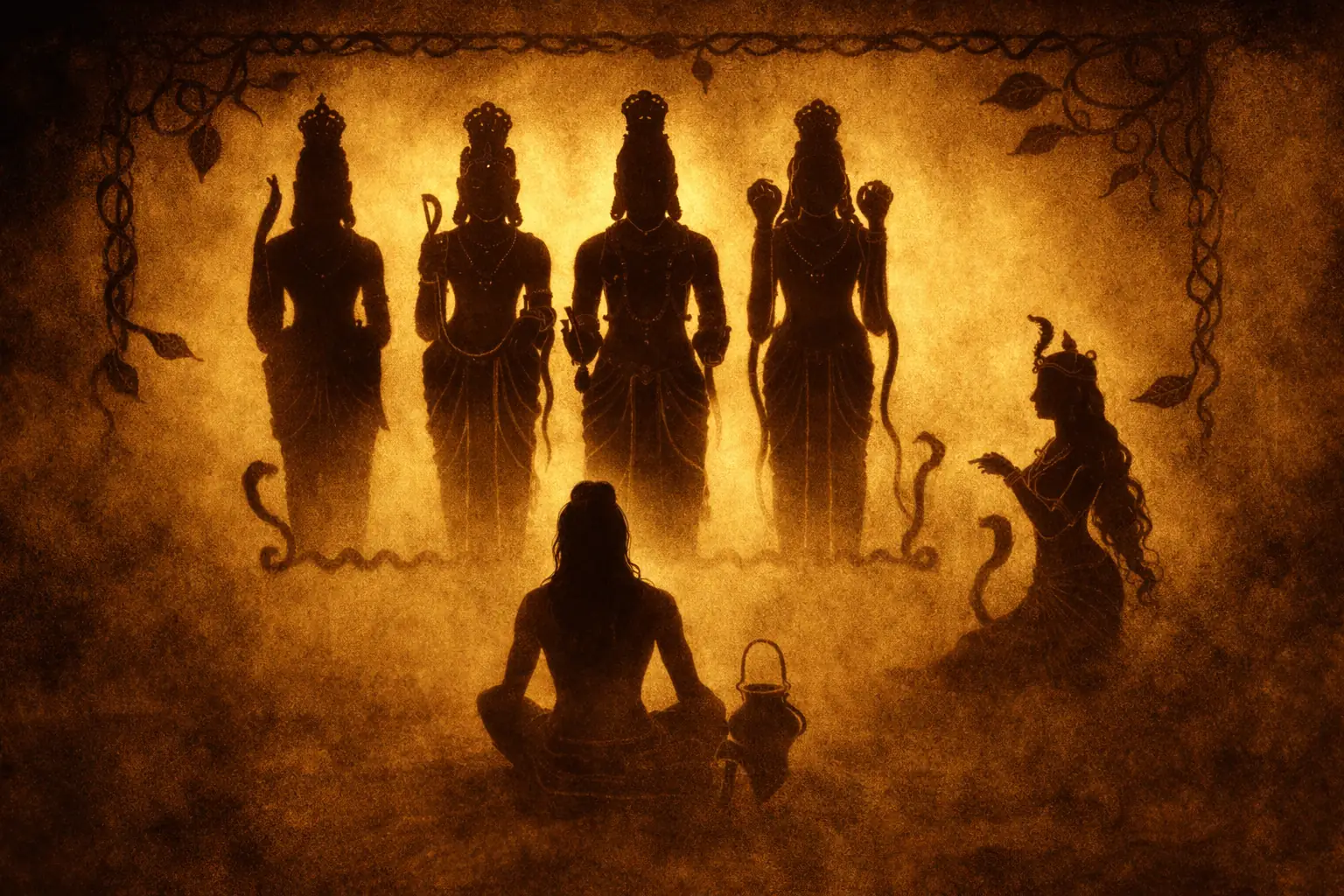
Installation of the revered Nāga deities.
With meticulous devotion, Parasurama then installed the revered Nāga deities— Goddess Śarpayakṣi, Goddess Nāgayakṣi, and Goddess Nāgachamundi—each in their destined places, accompanied by precise and powerful rituals. To the resonant chanting of the Vedas and the soulful melodies of holy hymns, he performed the sacred rites: Abhiṣekam (the ceremonial bath), Alaṅkāram (the divine adornment), offerings of Nivedyam, the light of Nīrājanam, and the profound offering of Sarpabali.
Through these acts of supreme devotion, he brought profound joy to the entire realm of the serpents.
Understanding that a sacred ecosystem requires both spiritual and earthly guardians, Parasurama brought learned sages from distant lands. He installed Goddess Durgā Devī and other deities at strategic points to protect the land.
Finally, having laid the foundation for a living, breathing sanctuary, Parasurama imparted the eternal principles to preserve its sanctity for ages to come. His earthly duty complete, the great sage withdrew, departing for the silent peaks of the Mahendra mountains, there to merge once more into deep, contemplative tapas—leaving behind a realm forever blessed and protected by Lord Sree Nagaraja.
The Sacred Beginning of Mannarasala
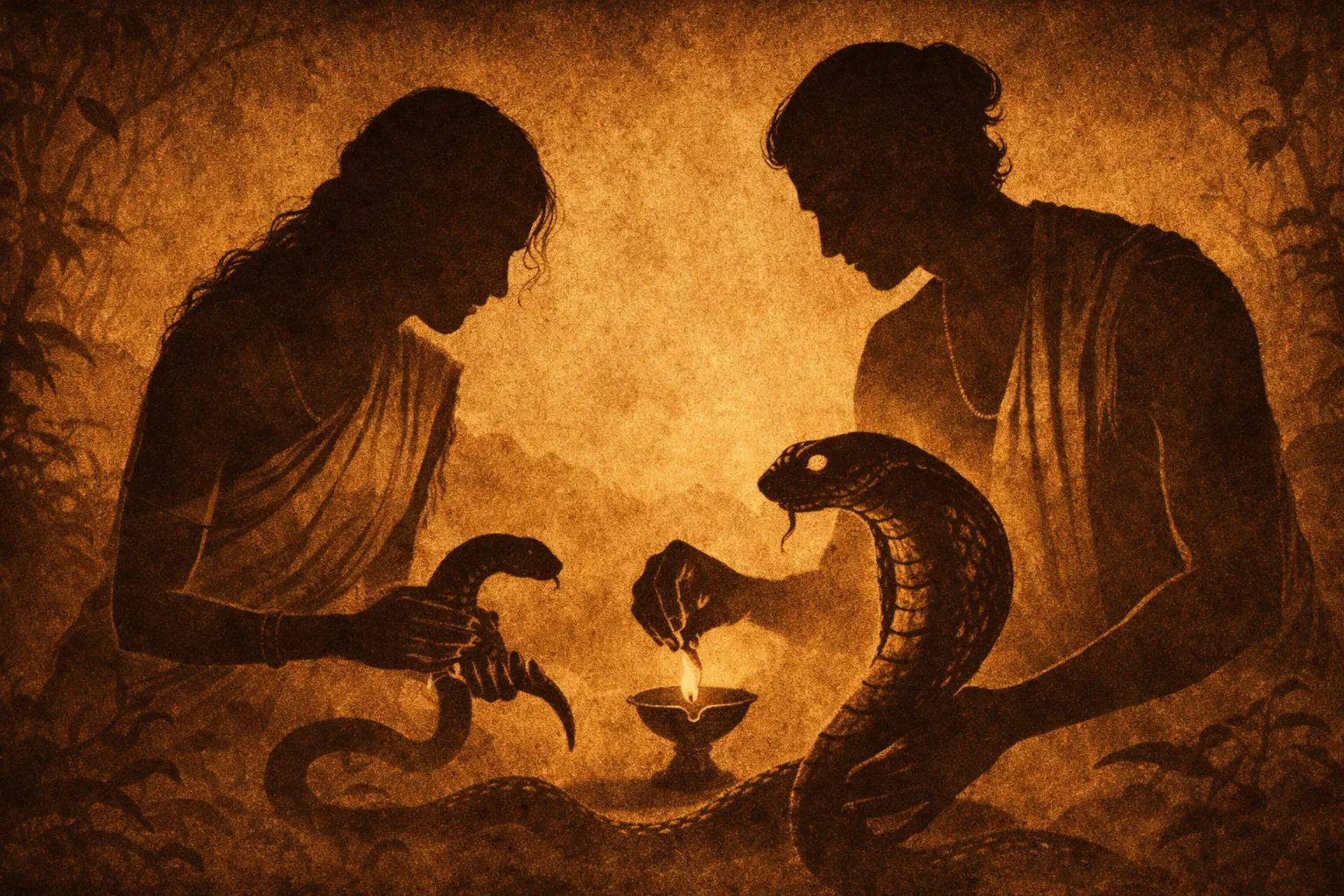
Vasudeva and Sreedevi tending to the scorched serpents.
In the generations that followed Parasurama’s departure for the Mahendra mountains, the Brahmin family entrusted with the temple’s care was shadowed by a profound grief—childlessness. The couple, Vasudeva and Sreedevi, carried this sorrow with heavy hearts, yet turned resolutely to worship, seeking solace at the feet of Lord Sree Nagaraja.
During this period of devout penance, a sudden wildfire swept through the jungle surrounding Sree Nagaraja’s dwelling. The sacred grove was engulfed; serpents writhed in agony, their hoods charred, bodies scorched, forced to retreat painfully into their smoking pits. Many lay faint and wounded, struggling to move upon the earth.
Moved by compassion, Vasudeva and Sreedevi became tender guardians to the afflicted Nagas. They fanned them with fans of sweet-scented grass, soothed their burns with ghee blended with honey and oil, and cooled their fevered scales with sandalwood ointment. Gently, they carried the serpents to the shelter of ancient banyan trees, consecrated their burnt pits, and prepared shaded sanctuaries beneath deodars and within sacred Chitrakudas.
With meticulous devotion, the couple performed Abhishekam with Panchagavya (five holy elements), offering fragrant flowers, incense, and prayers. They prepared Nivedyam—a sacred offering and Noorum Palum, an elixir of renewal - made of grounded rice and milk followed by an offering of turmeric and tender coconut water . They presented appam, aval, and tender coconut with unwavering reverence, chanting Vedic mantras and performing circumambulation, until the serpent multitudes were restored to vitality.
Sree Nagaraja, omnipresent and omnipotent, witnessed their steadfast penance and profound kindness toward his kin. Pleased, he manifested before the couple and bestowed a divine promise:
“I shall take the form of a serpent and dwell here eternally, for as long as the sun and moon endure. I will shower prosperity upon your lineage and extend my protection to all devotees who seek refuge at this sacred site.
Thus, Mandarasala—the grove of Mandara trees, where serpents found shelter and the earth was cooled—transformed into Mannarasala: a portmanteau of three words mann (earth), ariya (cooled), sala (place). A name born from compassion, consecrated by grace, and forever blessed by the eternal presence of Lord Sree Nagaraja.
The Sacred Soul of Mannarasala
In the fullness of divine time, Lord Sree Nagaraja’s promise to Vasudeva and Sreedevi blossomed into reality. Their once-quiet home was graced with two remarkable children: a human son, and a brother born as a five-hooded serpent—a living incarnation of Anantha (Sree Nagaraja himself).
The brothers grew side by side, bound by an extraordinary kinship. They received sacred initiation and Vedic learning in the timeless traditions of their lineage. When the time was right, Nagaraja—speaking through his serpentine form—instructed his human brother to enter into matrimony, ensuring the family’s continuity and its sacred duty. The brother obeyed, anchoring the household in the rhythms of worldly and spiritual life.
When Sree Nagaraja perceived that his earthly purpose was fulfilled—the lineage secured, the worship established—he turned to his Mother, Sreedevi. He spoke of his intent to withdraw, not in departure, but in eternal presence. He would enter a state of deep samadhi within the family home, the Illam, to remain forever as a living source of blessings for all devotees.
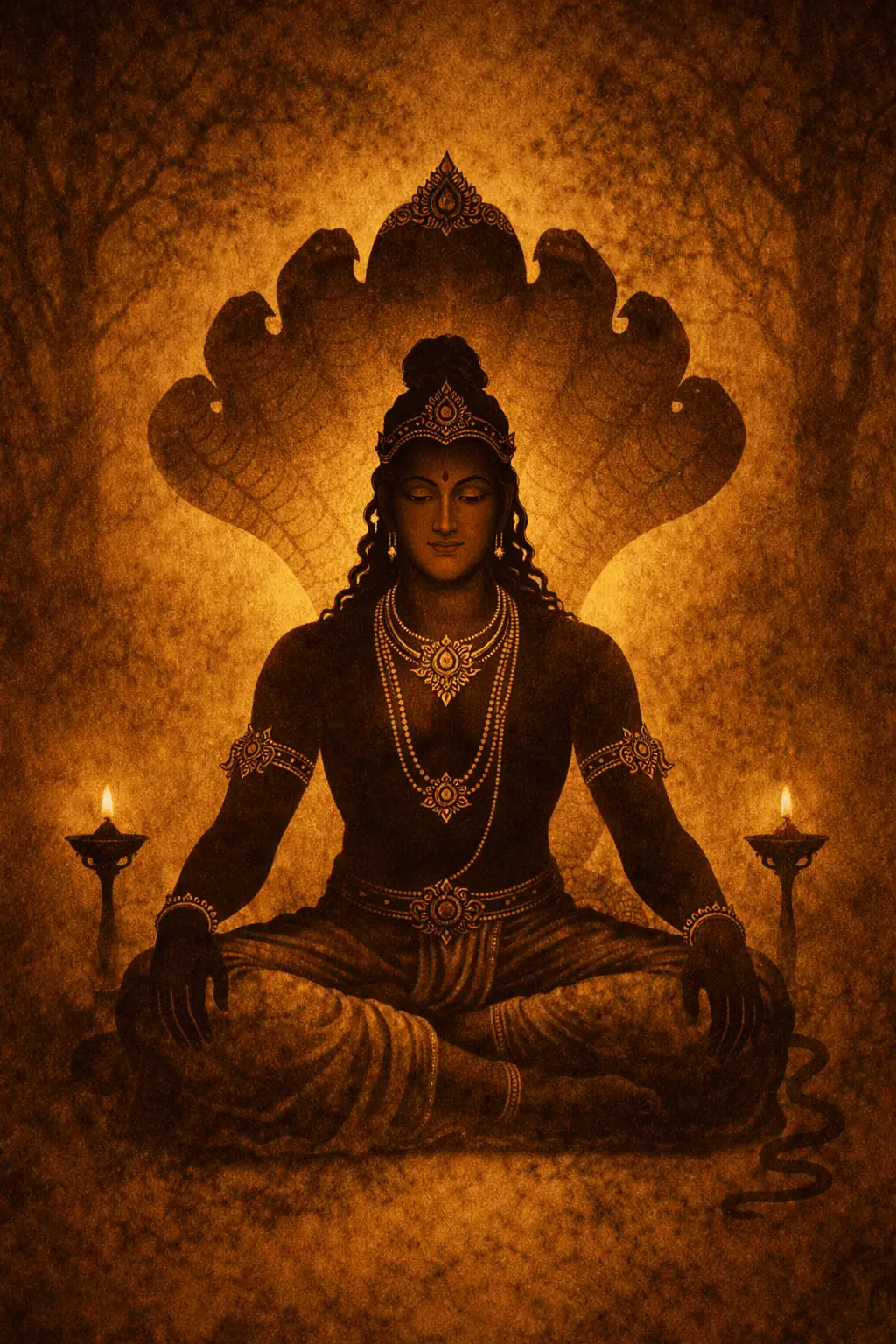
Lord Sree Nagaraja (Lord Anantha) in his eternal tapas inside the Nilavara
Before withdrawing, he entrusted the family with specific, inviolable rituals—the precise ways of worship, offerings, and conduct that would honor his abiding grace. Then, the five-hooded form of Sree Nagarala moved into the immaculate sanctum beneath the home: the Nilavara, the sacred cellar. There, he is believed to have vanished from mortal sight, yet not from presence.
To this day, it is held that Sree Nagaraja abides within the Nilavara, engaged in eternal tapas. His meditation is not for himself, but for the boundless prosperity and protection of his dependents—the family, the devotees, all who seek him. With tender reverence, the generations of the Illam refer to him not by formal title, but by the intimate, honorable name: Muthassan (grandfather).
And nearby lies a hallowed grove, the Appoppan Kavu, preserved in timeless quiet. It is his exclusive sanctuary, a living forest where his unseen peregrinations continue, where earth and devotion meet in unhurried grace.
Thus, the Nilavara is more than a cellar; it is the living soul of Mannarasala Illam—a hidden heart where a divine Grandfather breathes in meditation, and where every whispered prayer meets the stillness of a five-hooded blessing.