Sacred Celebrations
Festivals
The spiritual calendar of Mannarasala is marked by profound devotion, transforming the sacred grove into a vibrant tapestry of faith.
The spiritual calendar of Mannarasala is marked by profound devotion, culminating in the grand celebrations of the Ayilyam days in the months of Kanni, Thulam and Kumbham, along with the revered Maha Sivarathri. These festivals transform the sacred grove into a vibrant tapestry of faith, royal legacy, and divine communion.
Kanni Aayilyam
Among the temple’s annual observances, Kanni Aayilyam holds the most profound ritual significance. It commemorates the sacred birth anniversary of Lord Sree Nagaraja and is marked by an intensity of devotion, royal adornment, and meticulous ceremonial sequences. The day begins with the deities being grandly decorated, embodying their full divine splendor. The Chief Priest, who is the head of the temple’s hereditary family, conducts the primary poojas with solemn Vedic precision. Upon completing these initial rites, the Chief Priest proceeds to Mannarasala Illam to initiate the drawing of the sacred Padmam—a ritual mandala or geometric diagram. This act symbolically concludes the morning worship and signals the commencement of the deeper, more elaborate rituals to follow. After he draws the first lines, other family members join to complete the holy diagram, which will serve as the consecrated platform for the main Aayilyam Pooja performed by Amma. In the afternoon, a majestic holy procession, the Ezhunnallathu, begins. This is no ordinary procession; it is a symbolic homecoming. The utsava vigraha (holy idol) of Lord Sree Nagaraja is carried reverently by Amma from the temple to the Illam along with the other three main deities (carried by Cheriya Amma and other senior members) of the Temple. This movement underscores the inseparable bond between the temple and the ancestral household, the Illam, which is the spiritual nucleus of Mannarasala. It is here, within the Nilavara (the sacred underground chamber) of the Illam, that Sree Nagaraja resides eternally in the form of Lord Anantha, in deep meditative communion. The Ezhunnallathu thus represents the deity’s annual return to his eternal abode for his birthday worship.
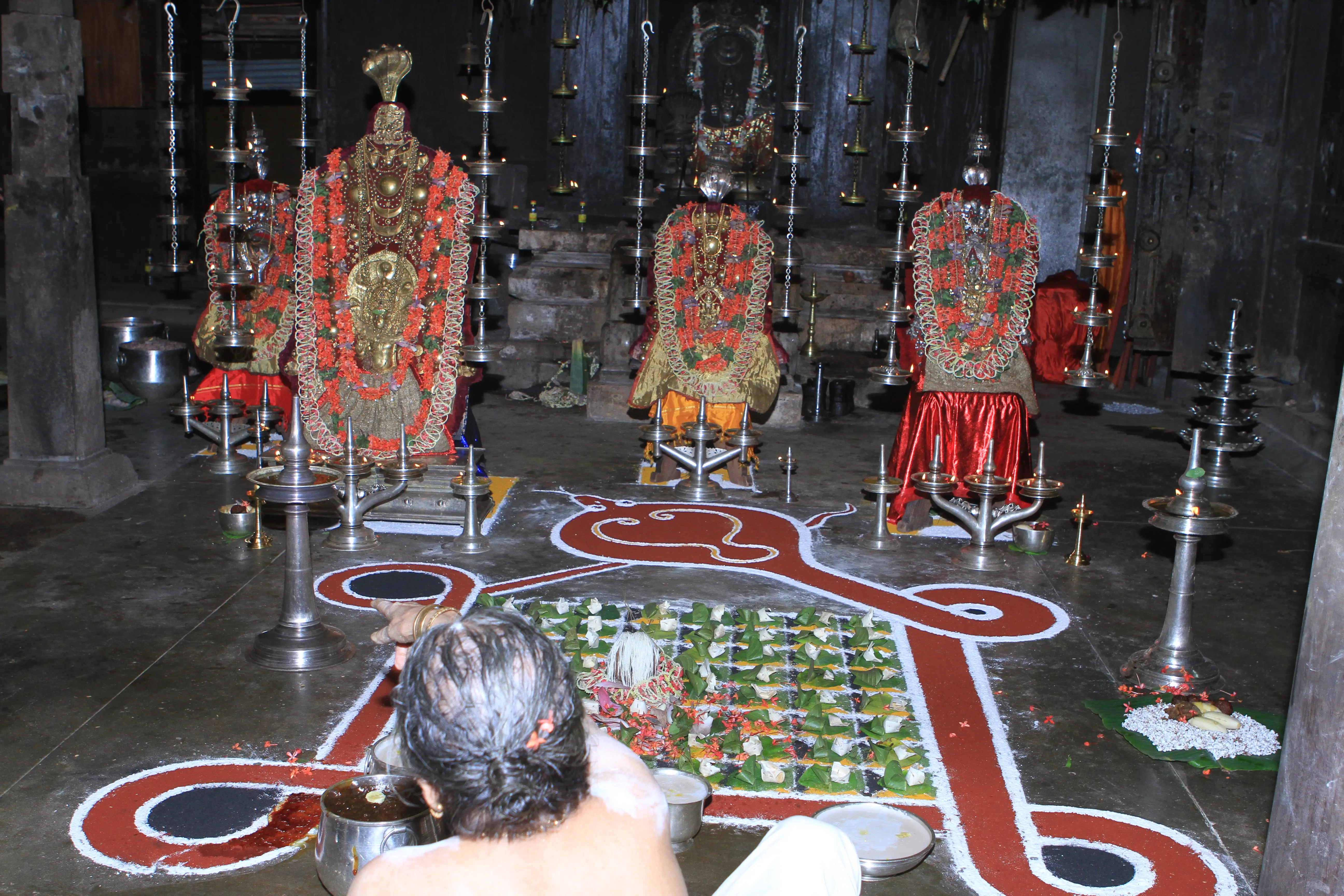
At the Illam, Amma performs the central Aayilyam Pooja upon the completed Padmam with focused devotion, in the intimate presence of the family and the deity's perennial form. A Guruthu Pooja is also offered to Goddess Nagayakshi and Goddess Nagachamundi following the completion of the Aayilyam pooja.
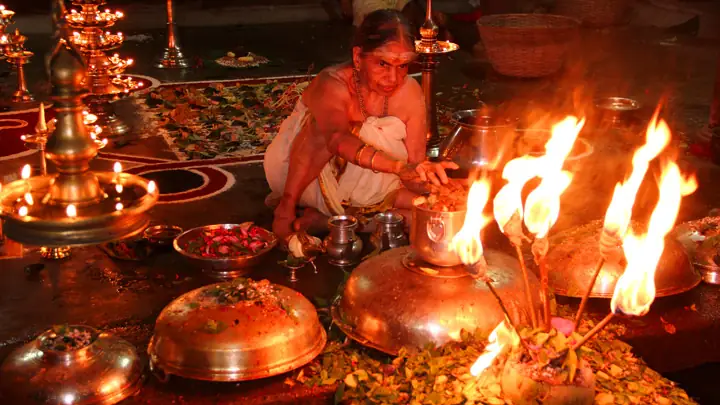
The day’s sacred cycle concludes with the Thattel Noorum Palum ceremony, conducted by the family head, formally marking the end of the Aayilyam day’s worship. Amma then returns to the temple for a final darshan on this most auspicious day, completing a continuum of rituals that honor the birth, the journey, and the eternal, dual presence of the Serpent King—both in the temple of the people and in the sacred heart of the home
This year’s Kanni Aayilyam falls on 06 October 2026, Tuesday.
Plan your temple visit.
Thulam Aayilyam
The Aayilyam festival in the month of Thulam, renowned worldwide simply as Mannarasala Aayilyam. Its preeminence has an origin in distant history. Originally, the Aayilyam day in Kanni was the primary observance. It was customary for the Maharaja of Travancore to undertake an annual pilgrimage to the temple on this day. On one historic occasion, the royal journey was delayed, compelling the Maharaja to defer his visit to the Thulam Aayilyam. In a gesture of both devotion and atonement, the royal palace assumed all expenses for that year’s celebration and endowed the temple with extensive lands, free from tax, to ensure the festival’s future grandeur. Thus, through royal grace and repentance, the Thulam Ayilyam was bestowed with an enduring splendor and has since shone as the temple’s most majestic festival.
This year’s Thulam Aayilyam falls on 02 November 2026, Monday.
Plan your temple visit.
Kumbham Aayilyam
The Aayilyam day in the Kumbham is also celebrated with befitting magnificence. In their core rituals and spiritual significance, it is equal to the Kanni Aayilyam. Kumbham Aayilyam honours the birthday of Lord Anantha, the venerable Muthassan who resides in eternal meditation within the Nilavara. Another vital annual observance is the Pulasarpam Pattu, conducted at the Pulakkavu, a sacred grove northeast of the Illam. This significant rite is traditionally held either on the Aayilyam day in Kumbham or on whichever Aayilyam follows thereafter, weaving another thread of devotion into the temple’s eternal cycle of worship.The primary offering here is the revered **Noorum Palum**, the elixir-like mixture of rice flour and milk.
This year’s Kumbham Aayilyam falls on 01 March 2026, Sunday.
Plan your temple visit.
Ezhunalathu: The Divine Procession
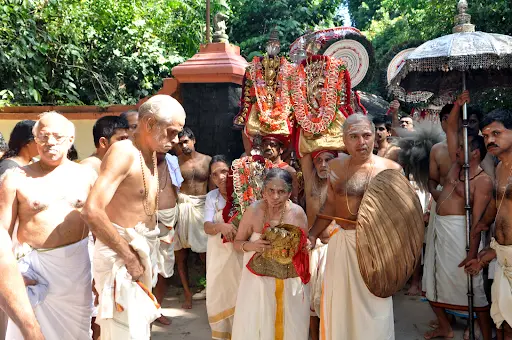
All three Ayilyam festivals feature the solemn and spectacular Ezhunalathu, the holy procession. In this sacred pageant, Valiya Amma, bearing the idol of Lord Sree Nagaraja, leads the way from the temple to the ancestral Illam. She is followed in solemn order by Cheriya Amma, carrying the idol of Goddess Sarpayakshi, and the two senior-most male members of the family, who bear upon their heads the idols of Goddess Nagachamundi and Goddess Nagayakshi.
Upon reaching the Illam, Valiya Amma performs her daily Thevaram worship, followed by the special Aayilyam pooja. While the Aayilyam pooja is observed every month, the majestic Ezhunalathu procession is a unique spectacle reserved only for the festivals of Kanni, Kanni and Thulam.
Maha Sivaratri
At Mannarasala, the sacred Maha Sivaratri is observed with solemn grandeur, holding a place of equal importance among its annual festivals. This profound connection stems from the very nature of the temple's principal deity; Lord Sree Nagaraja’s installation aligns with the essence of Lord Siva, and the worship follows a devoutly Saivite model. Thus, Maha Sivaratri resonates with special significance here.
The Sivaratri celebrations are intimately linked to Sree Nagaraja, the majestic King of Serpents. Legend whispers of a time when Sree Nagaraja, in a playful mood, coiled around the colossal Thanni tree before the temple. Stretching his jewel-bedecked hoods eastward, he let out a mighty hiss, scattering the sands and creating a tranquil pool known as the Karoli Kulam. It is believed that on Sivaratri night, Sree Nagaraja proceeds in a sacred procession toward this very pond, as if to gaze upon his own playful creation.
Sivaratri holds another exclusive distinction: it is the only day when the Deeparadhana, the ceremonial evening pooja, is performed at Mannarasala. This rite is conducted by the senior-most male member of the family.
As the evening pooja concludes, Valiya Amma herself commences the profound ritual of Sarpabali. She performs the offerings on the platforms before Lord Sree Nagaraja and Goddess Sarpayakshi. The rice for the Noorum Palum used in this Sarpabali is ground in sacred Ural (mortar) by members of the Illam—a voluntary, sacred act, for this Sarpabali on Maha Sivarathri is the unique offering of the Mannarasala family. On the completion of Sarpabali, Valia Amma begins the Guruthi Pooja, a special offering to Goddess Nagayakshi and Goddess Nagachamundi.
This special offering on Sivaratri honors Lord Sree Nagaraja’s profound attachment to Lord Shiva, the sarpabhushana who wears serpents as ornaments. In the final quarter of the night, a majestic procession forms. The senior-most male members carry the idols of Lord Sree Nagaraja and Goddess Sarpayakshi on their heads, journeying eastward from the temple to the foot of a divine tree half a kilometer away. Circling the Illom and returning to the sanctum from the south, the procession arrives as the scarlet glow of dawn breaks the horizon. The grandeur is magnified by the light of traditional torches (theevettis), shimmering silver umbrellas, ceremonial fans (Aalavattam and Venchamaram), and the sacred sounds of musical instruments. Compared to other public festivities, Sarpabali remains a deeply intimate ritual of the Illam, a covenant between the deity and his chosen family.
The following day, a unique annual ritual unfolds in the sanctum of the Nilavara, where Lord Sree Nagaraja resides as Lord Anantha (known as Muthassan). Only once a year is the sacred Noorum Palum offered within Nilavara. Following this sacred rite, offerings of Noorum Palum and other poojas are made in the Appooppan Kavu, the sacred grove that serves as the abode of Muthassan.
Five days after Sivaratri, Valiya Amma, upon completing her daily temple worship, proceeds to the Illam to open the Nilavara. She then distributes the prasadam of the Noorum Palum among the family members.
This year’s Maha Shivarathri falls on 15 February 2026, Sunday.
Plan your temple visit.
Sarpam Pattu
The offering of a lifetime, Sarpam Pattu is considered the most pleasing of all offerings to the serpent deities. Though a rare and immensely laborious ceremony, it is ordained to be conducted once every forty-one years. Only a fortunate few are blessed to witness this sacred event twice in their lifetime.
Historical records note its observance several times. Since 1073 M.E. (Malayalam Era), it has been held continuously with but one exception. The details from the ceremony of 1074 M.E. are meticulously preserved, and the Sarpam Pattu of 1151 M.E. (1976 C.E.) captured widespread public devotion.
The execution of Sarpam Pattu demands vast resources and dedicated manpower over many months. The pooja, which may extend for weeks, involves six or seven Kanyakas (young maidens), Cheriya Amma, and Valiya Amma, continuing until Valiya Amma, in a divine trance, receives the assurance that Nagaraja is satisfied. Separate worship is offered to nine serpent forms: Lord Nagaraja, Goddess Sarpayakshi, Goddess Nagayakshi, Goddess Nagachamundi, Nilavara Muthassan, Kuzhi Nagam, Kari Nagam, Mani Nagam, and Para Nagam. The women of the family who participate observe strict vows, abstaining from rice meals throughout the ritual period.
The sacred altar, the Yajnavedi, is situated in the courtyard south of the Nilavara. This space transforms into a breathtaking world of devotion during the ceremony. Intricate floor decorations (kalams), ancient songs, serpent dances, sacrifices, and offerings of Noorum Palum are performed in Valiya Amma’s presence, all accompanied by resonant music and chants. For the duration, the temple gates remain unclosed. The rites continue day and night, culminating on the day when Valiya Amma becomes divinely possessed and utters prophetic announcements for the devotees and the land.
Pallippana and Gandharva Pattu
The sacred cycle continues in the year following Sarpam Pattu with Pallippana, a powerful ritual performed by the Velan community. The year after Pallippana witnesses Gandharva Pattu. For this ceremony, skilled Kurups draw elaborate mystic diagrams (Kalam) on the ground. Valiya Amma then performs the pooja within these sacred geometries, invoking celestial harmonies in a ceremony known as the Gandharva Pattu (Songs of Gandharavas), thus completing a transcendent cycle of worship that spans years and links heaven to earth.
A Sacred Interlude: The Period of Serpent Hibernation
In alignment with the natural rhythms revered in serpent worship, a period of ritual observance is maintained from Edavam 15 (typically the last week of May) until Kanni Aayilyam. During this time, it is believed that the serpents enter a state of dormancy. In deference to this sacred cycle, Noorum Palum Pooja and other significant invocational rituals—such as Sarpabali, Ashta Naga Pooja, and Palpayasam Homam—are not conducted, so as not to disturb the hibernating Nagas. The sole exception is the Noorum Palum offered as part of Amma's Aayilyam Pooja on the monthly Aayilyam days during this period. All other elaborate propitiations resume only after the completion of Kanni Aayilyam, which marks the ceremonial awakening and renewed divine availability of the serpent deities, thus harmonizing temple worship with the ecological and spiritual ethos of nagaaradhana.
Vrischikam: The Sacred Month
The Malayalam month of Vrischikam holds profound religious significance at Mannarasala Temple. Following the festivities of Thulam, this period is marked by spiritual reflection, rigorous fasting, and ascetic practices. The chief priest (the head of Mannarasala Illam) observes a strict regimen of fasting and austerity while conducting daily rituals throughout the month. He is required to remain within the temple premises continuously until Vrischikam concludes. A key ritual during this period involves the daily offering of Navakam accompanied by panchagavyam (a sanctified blend of five cow-derived substances) to Lord Sree Nagaraja and Goddess Sarpayakshi. This is followed by additional worship ceremonies, including the presentation of Nivedyam (ritual food offerings), Noorum Palum offerings that is performed within the sanctum sanctorum (Garbhagriha) of Lord Sree Nagaraja—an observance unique to this period. The month culminates with the Kalabham (sandalwood paste) ceremony, presented to the deities after the final Navakam offering on the concluding day of Vrischikam. This sacred month represents a period of intense devotion and the preservation of ancient ritual traditions at Mannarasala.
Gandharva Pooja
The Gandharva Pooja is a significant ceremonial observance performed on the 41st day of the sacred Vrischikam month at Mannarasala Temple. This ancient ritual is conducted under the solemn guidance of the Mannarasala family head, serving as both a spiritual obligation and a bridge between the earthly and celestial realms. The pooja is dedicated to propitiating the celestial Gandharva deities: Chithrarathan - The divine musician embodying artistic perfection Viswavasu - The primordial Gandharva king representing cosmic harmony This ritual serves multiple sacred purposes: harmonizing human and divine energies through Gandharva worship and Invoking blessings for music, arts, and creative expression